
AI Commerce NewsEcommerce
Classic storefront search was built for shoppers who already know what they want
Site search matches words to products. Shoppers now arrive with a need, a deadline and a sentence, and a ranked grid of single items can't answer that.
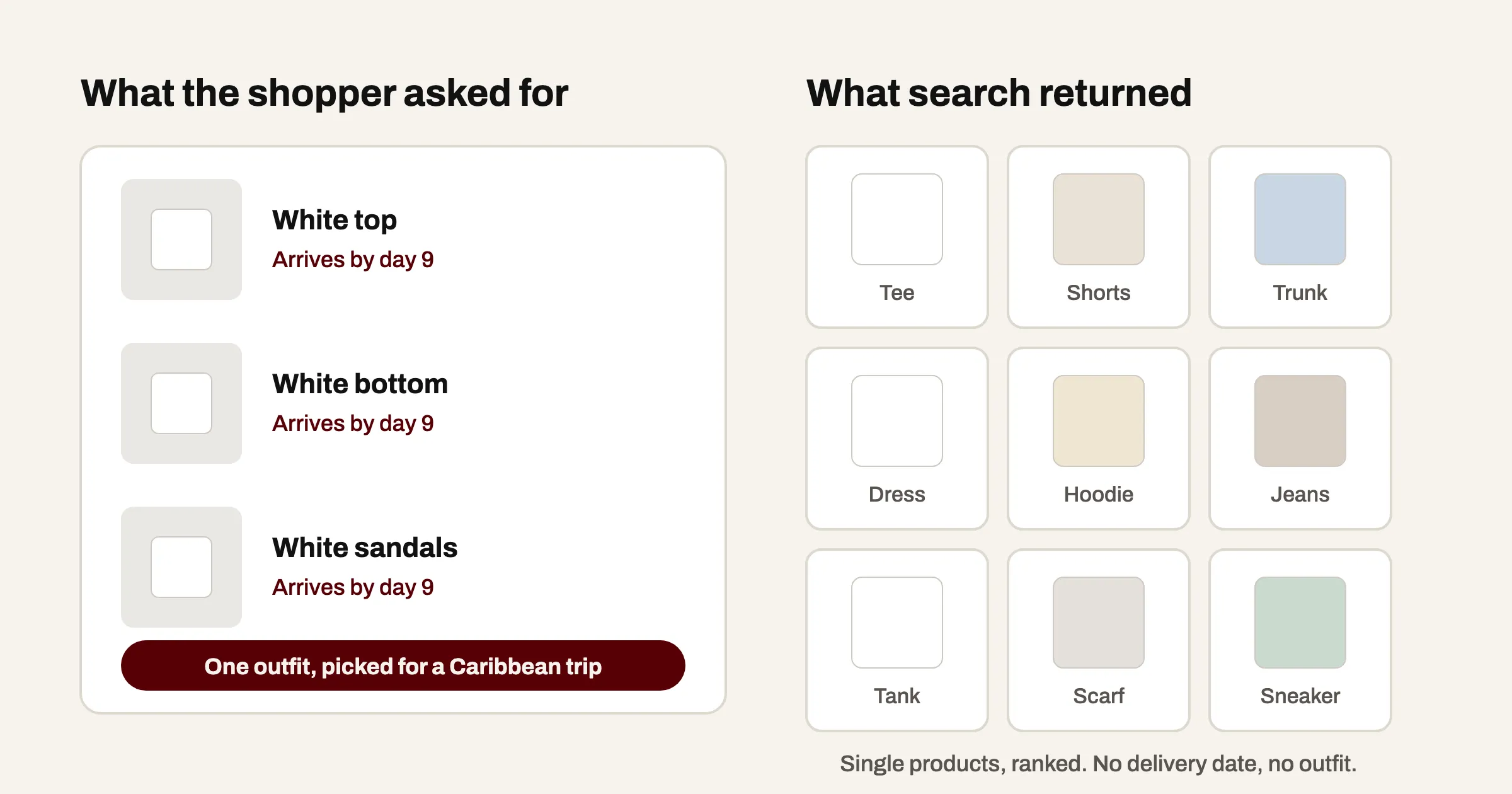
The search box on most storefronts does one job well. You type words, it finds products whose records contain those words, ranks them, and hands you filters to narrow the list. If you know you want a white linen shirt in a medium, that is exactly the tool you need.
The trouble is how few shoppers arrive that way. Someone buying a gift for a person who fishes doesn’t know which reel to type. Someone furnishing a first apartment on a budget doesn’t have a SKU in mind. Someone flying out in eleven days needs to know what will arrive in time. They show up with a need and a set of constraints, and a shopper who is used to asking ChatGPT for things will type that as a whole sentence.
Classic search can’t do much with a sentence.
What happens when you hand it one
In August we typed one sentence, word for word, into the search box on three well-known apparel sites:
I need a white outfit for a Caribbean vacation in 11 days. Put something together for me.
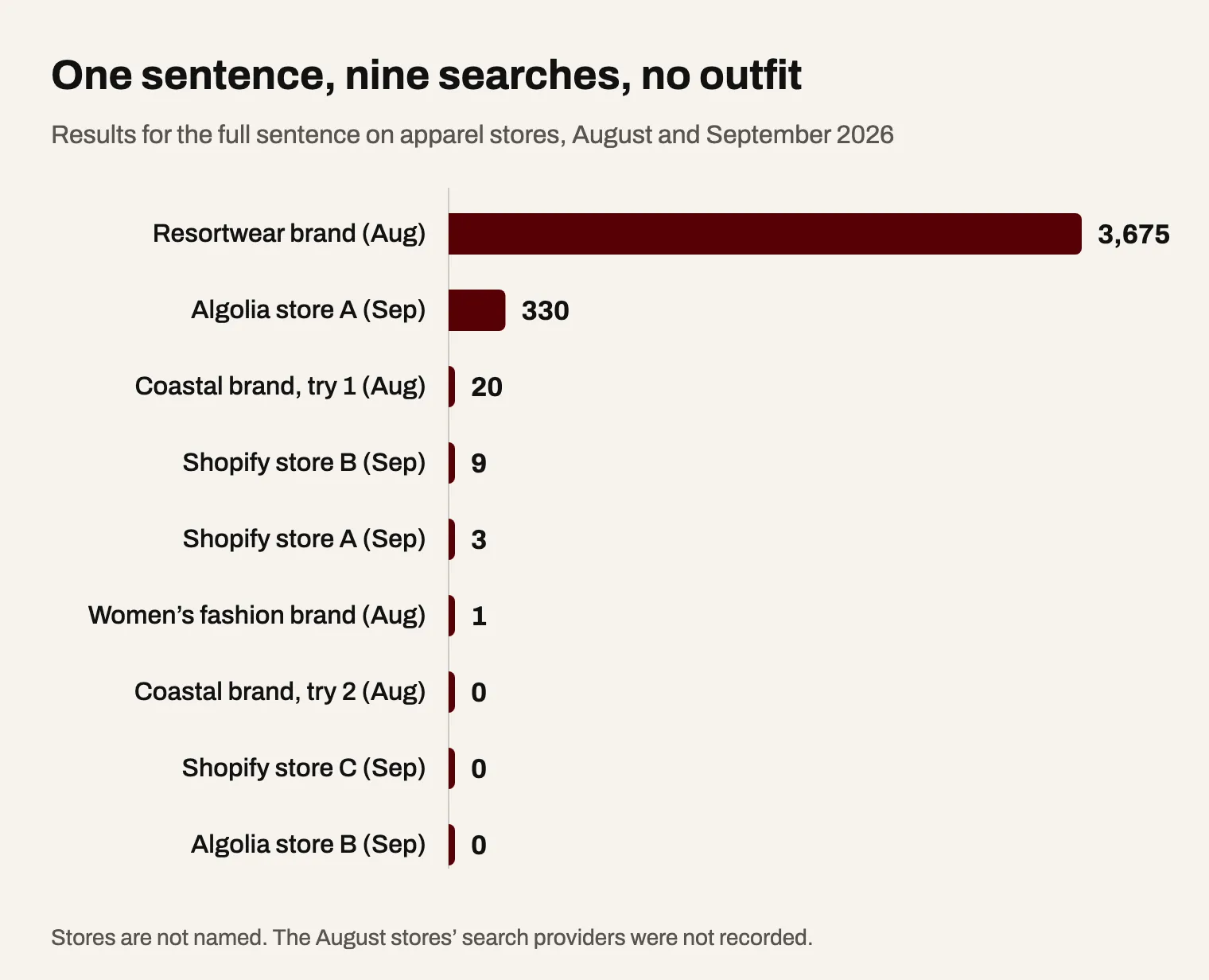
A resortwear brand returned about 3,700 products, most of its catalogue. The more we asked for, the more it returned: “dress” gave 1,008 results, “white dress” gave 1,323, and “white dress caribbean” gave 1,459. Each extra word was treated as another thing to match, so every detail the shopper added made the list longer.
A coastal apparel brand returned twenty products one hour, including an ivory sweatshort and a blue print trunk, and “No products found” the next. A women’s fashion brand returned a single item.
The sentence contains five requirements: a colour, an outfit made of several pieces, an occasion and climate, a delivery deadline, and a request to choose. The colour was the only part any site acted on. One of them showed a shipping filter above the results promising delivery well inside eleven days, so it had the data. It just had no way to connect that data to the eleven days in the question.
What today’s search tools actually do
Storefront search has improved a lot, and the current tools are good. Looking at what they do is the clearest way to see where the limit is.
Shopify’s built-in storefront search includes semantic search. Shopify says it “goes beyond keyword matching” and lets customers “use everyday language when searching, even if they search for ‘something to wear in the summer’ instead of ‘shorts’.” That is a real improvement for vague queries. What comes back is still a list of products. Nothing in Shopify’s documentation describes search reading a delivery deadline out of a query or putting several items together. The closest thing to an outfit in Shopify’s Search & Discovery app is complementary products, which the merchant chooses by hand for each product.
Algolia, a search provider many retailers use instead, layers several tools on top of keyword matching. NeuralSearch “adds vector search to your keyword search, then merges and ranks the results.” Query Categorization predicts which category a query belongs to from past searches, clicks and conversions. Dynamic Re-Ranking uses clicks and conversions to reorder results, and Algolia’s docs are plain about its limit: it “only reorders records that are already eligible to appear in the results (it doesn’t add new records).” Each of these makes the ranked list better. None of them changes the fact that the answer is a ranked list.
Algolia also offers Agent Studio for building AI shopping assistants. The merchant supplies the language model, defines the agent, and connects whatever it needs to know, such as inventory. That’s an honest picture of where the industry is: the pieces exist as a kit, and the brand still has to build the part that knows what’s in stock, what arrives in time and what goes together.
| Shopify search | Algolia | |
|---|---|---|
| Understands everyday language | Yes (semantic search) | Yes (NeuralSearch) |
| Reorders results by clicks and sales | Not described | Yes (Dynamic Re-Ranking) |
| Reads a delivery deadline | Not described | Not built in |
| Puts several items together | Merchant picks by hand | Build it yourself (Agent Studio) |
| What the shopper gets back | A ranked list | A ranked list |
From Shopify’s and Algolia’s documentation, September 2026. “Not described” means we found nothing in the vendor’s docs.
This week we typed our sentence into stores running each of them. On one Algolia-powered apparel store it returned 330 results, led by platform boots. On another it returned nothing, while “white dress” on the same store returned 329. Shopify stores ranged from zero results, to nine T-shirts and tanks, to the best answer we saw anywhere: a white dress, a white swimsuit and a pair of white shorts. That last one is close to useful. It is also three separate products, with nothing to say whether any of them arrives in eleven days.
The shopper wanted an outfit, which is several items chosen to work together. They wanted things that arrive before the trip. They wanted someone to pick. Search takes that decision and hands it straight back to the shopper, along with a grid. The bigger the catalogue, the more grid there is to sort through by hand.
What the gap costs
The shopper who types that sentence is the one you most want. They’re on your site, they’ve told you what they need, and they have a date to buy by.
When the search box can’t help, they do the work themselves. They open tabs, check product pages one by one for fabric and shipping times, and try to picture the pieces together. Some of them email your support team the question the storefront couldn’t answer, and a person on your payroll types out what the product page already knew. Some shoppers just leave.
Others take the whole request to an AI assistant instead. It will happily reason about Caribbean weather and what goes with white linen. It can’t see which sizes you have in stock today or what ships in time, because that information belongs to you. The shopper gets a confident answer built on partial facts, and the sale may no longer be yours.
What “enough” would have to do
Search that could handle the sentence would need to read the request as a whole, including the parts that aren’t product attributes, like the occasion and the deadline. It would need your first-party facts: live stock, sizes, delivery estimates and what your products are actually good for. And it would need to answer in the shape of the question. Sometimes that’s a list. Often it’s a small set of things that go together, a comparison between two options, or a short answer to “will this arrive by the 27th.”
That’s a different job from retrieval. The buying decision still happens on your storefront, and for shoppers who arrive with a need instead of a product name, the search box is where that decision currently stalls.
Try it on your own site
Open your support inbox and find a question a customer asked before buying. Something like “which of these works for a toddler who’s just started walking” or “will this arrive before the 20th.” Type it into your own search box exactly as they wrote it.
Then look at what comes back, and ask whether it answers them.