
AEO gets you discovered. What happens after the click?
AI referrals send fewer visits than search, but they convert better. The shopper arrives with the research done, and most storefronts still greet them like a stranger.
In March 2025, shoppers sent to US retail sites by AI assistants converted at nearly half the rate of everyone else, by Adobe’s count. A year later, in March 2026, they converted 42% better (Adobe Digital Insights, Quarterly AI Traffic Report, April 2026). By July 2026 the gap was 60% (Adobe, AI Traffic Trends Report, August 19, 2026).
The shoppers did not change. The most plausible explanation is that they now arrive with the research behind them.
The channel is still small. Similarweb puts generative AI at 0.4% of retail ecommerce visits (State of Ecommerce 2026), and Adobe measured AI referral traffic to US retail sites up 62% year over year in July 2026. A small channel that is growing fast and sends unusually good buyers is worth understanding before it is big.
What AEO is for
Answer engine optimization is the work of making sure AI systems can find your products and describe them accurately: complete feeds, structured data, pages a crawler can read. It is worth doing, and we covered the infrastructure side in OpenAI Sponsored Agents vs. a Brand Agent.
It answers one question: when someone asks an AI about your category, does your brand show up, and is what it says correct? Then the shopper clicks, and AEO has nothing more to say.
What the shopper brings with them
Someone who clicks through from an AI answer has usually been told which products to look at and roughly why. They are not browsing. They are checking whether the page agrees with what the AI said, and whether it answers the question the AI could not.
Those questions are specific. In our research on brand storefronts this fall, we kept finding the same kinds of gaps.
- A fashion retailer’s product page says to size down, while the Q&A on the same page says true to size.
- Two sweater polos from one menswear brand list the same fit, the same fabric and the same price, and nothing on either page says how they differ.
- A jewelry brand sends a gift buyer who is choosing between two bracelets to a client advisor instead of answering the question.
- A denim brand’s size guide lists measurements only, and its customer care page says replies take up to two business days.
In each case, what the shopper needs to decide is missing, contradicted, or one support ticket away. An AI answer that lands someone on one of these pages has done its job. The page is where the sale is won or lost.
The page was built for a different visitor
Most storefronts greet every arrival the same way: a hero image, a grid, some filters. That design assumes a visitor who needs to be shown what exists. A visitor coming from an AI answer already knows what exists. What they need is help deciding.
Salesforce’s analysis of holiday 2025 points the same direction. It found that shoppers referred from AI search converted nine times as often as shoppers referred from social, and that retailers who launched their own shopper agents grew 59% faster (6.2% year over year against 3.9%). The second comparison is among Salesforce customers and is not a controlled test, so read it as direction, not proof. Salesforce also estimated that AI and agents influenced $262 billion of global online holiday spend, about 20% of retail sales. That figure covers AI broadly, including recommendations and agents on retailers’ own sites, so it is not ChatGPT’s share.
The upsell a static page misses
A shopper who arrives from an AI answer came for one thing. They have high intent, they know roughly what they want, and they are not clicking around. That is part of why they convert so well.
It is also why they rarely see anything else. They skip the related products, the bundles and the “complete the look” rows that a storefront counts on for add-on sales. On a static page, a better buyer can leave with a smaller basket.
A page that knows what the shopper asked can carry that intent further: the case that fits the camera they chose, the second piece that goes with the first, the refill they will need next month. That is revenue on top of the better conversion, not instead of it.
We tried it
We asked ChatGPT a question a real shopper might ask in November:
Which down jacket is warm enough for 10°F but packs small for travel?
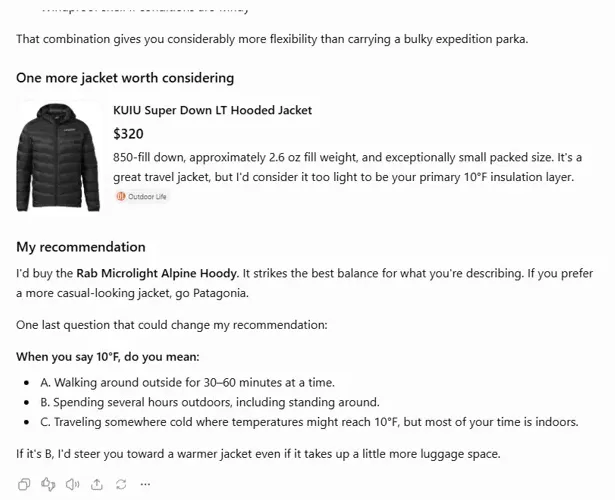
The answer was good. In a few seconds it named four jackets with prices and fill weights, explained the trade-off between warmth and packed size, made one recommendation, and then asked a question that could change it: would the shopper be walking around for an hour, standing outside for several, or mostly indoors? That is the work a good sales associate does, and all of it happened before the shopper reached a store.
Then we clicked the link under one of the jackets. It did not go to the brand that makes it. It went to a gear magazine’s roundup of the best down jackets, last updated in March 2024, with utm_source=chatgpt.com on the end of the address. That visit, and the shopper’s interest in that jacket, went to the magazine. The brand never saw it.
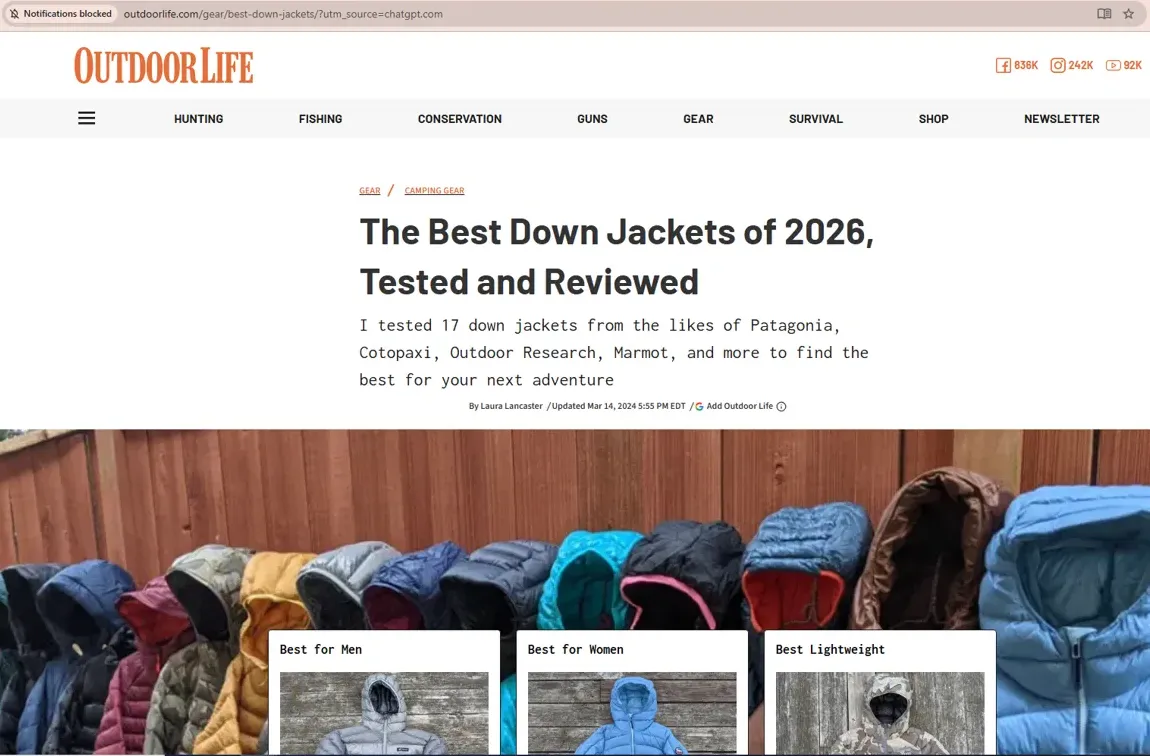
Two things follow. A click from an AI answer does not always land on your site: sometimes the answer cites someone else’s page about your product, and the visit is theirs. And when the shopper does reach your product page, they arrive with the trade-off weighed, a shortlist in hand and a specific use in mind, an hour of walking at 10°F, and the page knows none of it.
This is one question and one click, not a study. It takes ten minutes to try in your own category.
How to look at your own after-click experience
- Segment AI referrals in your analytics. Visits from chatgpt.com, perplexity.ai, gemini.google.com, copilot.microsoft.com and claude.ai often land in a generic referral bucket, and visits from the assistants’ mobile apps usually arrive as direct. ChatGPT adds
utm_source=chatgpt.comto many of its links, which makes those visits easier to find. - Look at which pages those visits land on, and what they do next. Do they search the site, open reviews, leave?
- Ask an AI assistant the buying question your customers ask most, and click every link it gives. Note how many land on your site, and how many on a review site or a retailer instead.
- Take the three questions your support inbox gets most about a product, and check whether the product page answers them.
Where this goes
AEO gets a shopper to the door. What happens next is a separate problem, and it is the one we work on at Syntrologie. We augment a brand’s existing storefront so it uses the brand’s own knowledge and the shopper’s intent to help them decide, and to build the basket, right where the purchase still happens. The next post covers what that is.