
AI Commerce NewsAI commerce
OpenAI Sponsored Agents vs. a Brand Agent: What Brands Actually Need to Build
ChatGPT Ads, product feeds, crawler access and MCP make a brand's information available to AI. Turning that into a decision for a shopper is a different job.
On September 16, OpenAI introduced Sponsored Agents: a new advertising format that lets a shopper click an ad in ChatGPT and start a clearly labeled conversation with an AI representative of the advertiser.
For brands, this is a meaningful change.
Until now, most of the work around appearing in ChatGPT has focused on discovery: making sure OpenAI can find your products, understand your catalog and accurately describe what you sell.
Sponsored Agents introduce a different problem.
It is no longer enough for ChatGPT to find your brand. An AI may now be expected to represent your brand, answer buying questions and help someone make a decision.
Those are two very different jobs.
OpenAI now provides much of the infrastructure a brand needs to participate. But having the infrastructure does not automatically produce a good brand agent.
Here is the difference.
What OpenAI gives a brand
There are several distinct pieces of OpenAI’s commerce and advertising stack.
1. Distribution through ChatGPT Ads
Businesses can create an advertiser account and run campaigns through ChatGPT Ads Manager. OpenAI uses the context and intent of a conversation, along with information from the advertisement and landing page, to determine when an ad may be relevant.
Sponsored Agents extend that experience. Instead of simply clicking through to a website, a shopper can choose to open a separate conversation with a business-sponsored agent, ask questions and then continue to the advertiser’s site.
As of September 17, 2026, Sponsored Agents are being tested with selected advertisers in the United States and are not available through open self-service enrollment. OpenAI has also not yet published a complete developer specification describing how advertisers configure the knowledge, tools and behavior behind a Sponsored Agent.
What this solves: access to shoppers inside ChatGPT.
What it does not solve: what your agent should know or how it should help someone buy.
2. Structured product data
Brands can give OpenAI structured information about their products through merchant feeds and commerce integrations.
For Shopify merchants, OpenAI says products are already integrated through Shopify Catalog when using the ChatGPT Ads app. OpenAI also supports merchant feeds independently, allowing merchants to submit structured product content under its Product Feed specification.
That is important. A structured catalog is substantially better than asking an AI to infer your assortment from arbitrary webpages.
It can provide information such as:
- product identity
- variants
- pricing
- availability
- product attributes
- shipping information
- return information
What this solves: What products does this brand sell, and what are their attributes?
What it does not solve: Which product is right for this particular person, given what they are actually trying to accomplish?
Those questions sound similar. They are not.
3. Website access
Brands should also make sure OpenAI can access the parts of their websites they want represented.
This matters because the catalog is only part of a brand’s knowledge.
A shopper may ask:
“Will this shrink?”
“Can I take this as a carry-on?”
“What’s the difference between these two models?”
“Can I return it after I’ve opened it?”
“Will this arrive before Friday?”
Some answers may live in the product feed. Many will live in product descriptions, FAQs, buying guides, shipping policies or other pages.
Making those pages accessible gives ChatGPT more information from which to work.
What this solves: What has this brand publicly said?
What it does not solve: Which information matters right now, and how should it be used to move this customer toward a decision?
That distinction becomes increasingly important as questions become more complex.
4. Live systems and first-party data through MCP
The next level is connecting ChatGPT directly to systems the public website cannot represent well.
OpenAI’s Apps SDK is built on Model Context Protocol, or MCP. Developers can create applications that expose external tools and data to ChatGPT, connect them to their own backend, and define application logic and interfaces.
For a commerce brand, that could mean exposing:
- live inventory
- estimated delivery dates
- detailed product knowledge
- compatibility information
- store availability
- account information
- order status
- proprietary recommendations or tools
This is much more powerful than crawling a website.
The AI can ask your systems directly.
What this solves: What does the brand know right now?
And this is where it becomes tempting to conclude that the problem is solved.
It isn’t.
Product access is not the same thing as a good brand agent
Imagine a shopper says:
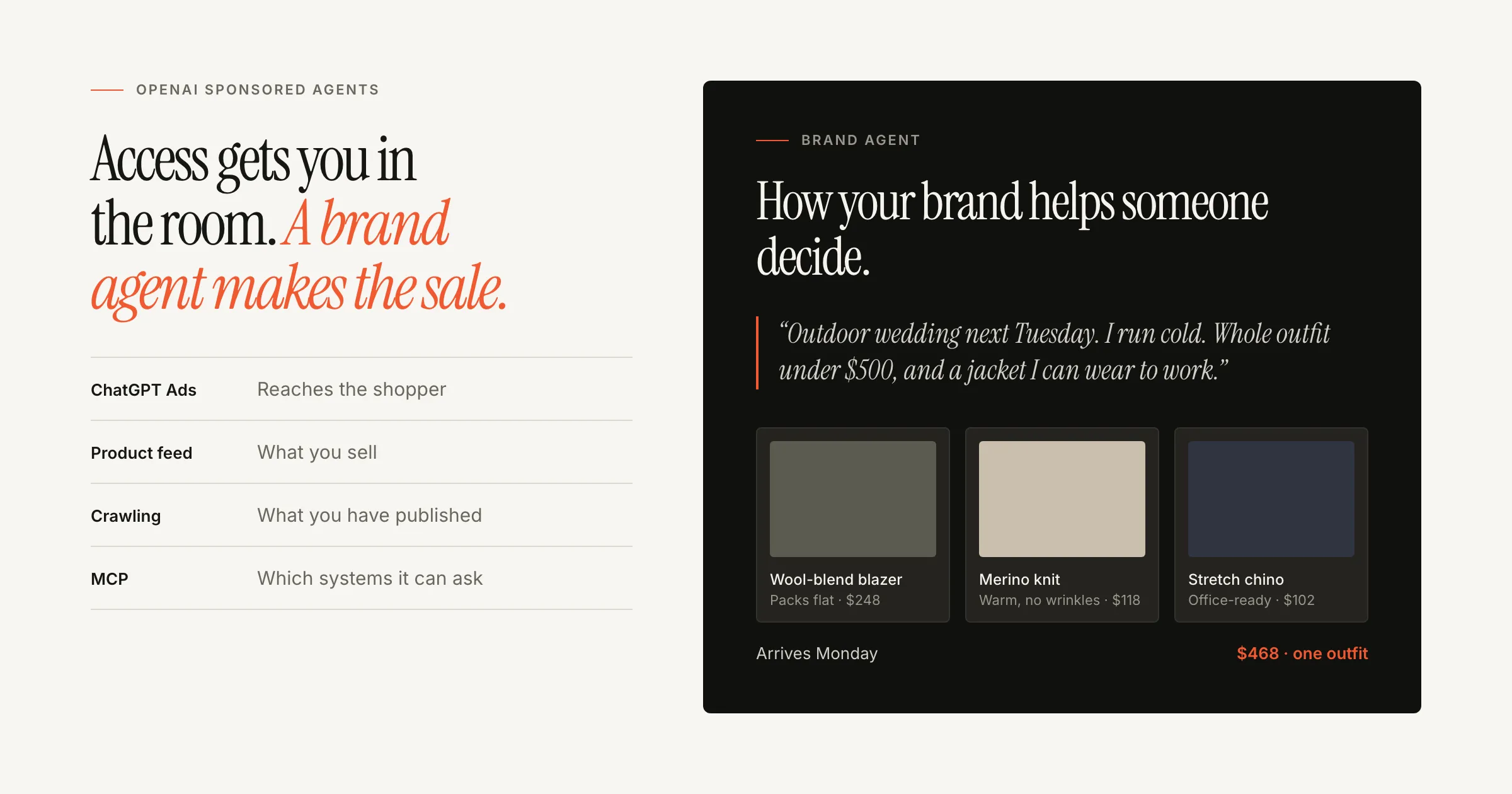
I’m going to an outdoor wedding next Tuesday. I run cold, I don’t want anything that wrinkles badly in a suitcase, I need the whole outfit under $500, and I’d like to wear the jacket again to work.
Assume you have done everything correctly.
OpenAI has your catalog.
It can crawl your site.
It can retrieve your shipping and return policies.
Your MCP server can give it live inventory and delivery dates.
Every piece of information necessary to answer the question might exist.
The remaining problem is deciding what to do with it.
The agent has to understand that this is not really a search for “men’s jackets.”
It needs to reason across several constraints:
outdoor weather, formality, warmth, wrinkle resistance, budget, delivery date, outfit compatibility and future use.
It needs to decide what information matters.
It needs to retrieve it from several different places.
It needs to compare alternatives.
It needs to decide what products to present and why.
And ideally, it should present the answer in a way that makes the decision easier rather than dumping six paragraphs of text into a chat window.
That is a different layer of the system.
The comparison
| Capability | OpenAI infrastructure | Brand Agent layer |
|---|---|---|
| Reach shoppers in ChatGPT | ChatGPT Ads / Sponsored Agents | Uses the available distribution surface |
| Tell AI what products exist | Product feed / Shopify Catalog | Understands how products relate to shopper needs |
| Make public brand information available | Website crawling | Determines which information matters for the current decision |
| Access live proprietary data | Apps SDK / MCP | Coordinates data across catalog, inventory, logistics and brand knowledge |
| Understand a complex buying goal | General-purpose model reasoning | Adds brand-specific decision logic and product expertise |
| Decide what to show next | Model can choose from available context/tools | Optimizes the next action around helping the shopper decide |
| Create the buying experience | ChatGPT provides the conversational surface; Apps SDK can provide custom UI | Generates the experience appropriate to the shopper and surface |
| Improve from commercial outcomes | Brand can measure downstream results | Feeds outcomes back into the system to improve future decisions |
The first column is becoming infrastructure.
The second is where brands differentiate.
Crawling is retrieval. A catalog is data. MCP is access.
This is the easiest mental model.
A crawler tells the AI what you have published.
A catalog tells it what you sell.
MCP tells it what systems it can ask.
None of those, by themselves, tell an agent how your brand should help someone decide.
That becomes especially obvious when a shopper’s question doesn’t map cleanly to a product attribute.
Someone buying fishing equipment may not know that they need a particular lure. They know the lake, season, weather and species they are fishing.
Someone buying skincare may describe the result they want rather than the ingredients they need.
Someone shopping for luggage may describe a ten-day trip through Europe rather than ask for a particular suitcase dimension.
People think in goals and constraints.
Product catalogs are organized into products and attributes.
The work of a good commerce agent is translating between the two.
What we would recommend brands set up today
Brands should still do all of the underlying work.
Open a ChatGPT Ads account if you are eligible.
Keep your product feed complete and current.
Make the pages you want represented accessible to OpenAI.
Clean up product information, policies, guides and comparison content.
Connect live first-party systems where MCP or another integration makes sense.
And test the resulting experience using real questions from customers rather than queries invented by your marketing team.
That infrastructure will increasingly matter regardless of who ultimately provides the shopper-facing agent.
But do not mistake making your information available to AI for building an AI that knows how to sell your products.
Where Syntrologie fits
Syntrologie starts where the underlying infrastructure ends.
We connect the Brand Agent to the catalog, live systems and first-party brand knowledge, then use the shopper’s intent to determine what information is needed, which systems should supply it, what should happen next and how the resulting experience should be presented.
The same brand intelligence can then power the brand’s own storefront and AI surfaces that can connect to it.
The goal is not simply to make brand information accessible to an LLM.
It is to let someone shop the way they actually think: describe what they are trying to accomplish and have the brand assemble the information, products and experience necessary to help them decide.
OpenAI is making it increasingly possible for every brand to have an AI representative.
The next question is whether that representative actually knows how to sell.